HOW TO READ · 2026-09-03
The day's guides
Tools
A Denarius Was a Day's Wage
Numbers in Scripture go flat until you know what they used to buy.
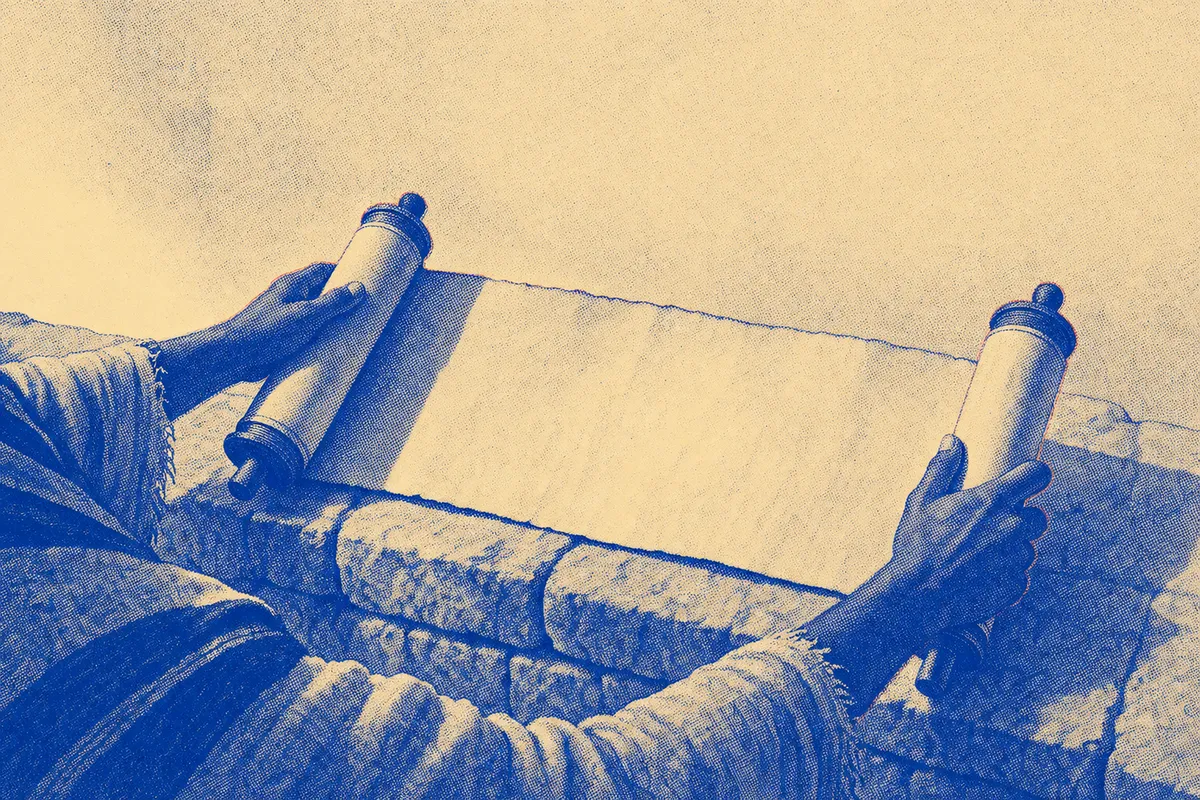
Scripture is full of numbers that modern readers glide past because they don't mean anything to us. A cubit, a shekel, a denarius, a talent — these sound like fantasy currency until you convert them into something you can hold in your head. Do that conversion, even roughly, and whole passages change weight.
Take the ark's dimensions in Genesis, or the temple's in Ezekiel: three hundred cubits is close to a football field and a half. That's not a detail to skim — it's the difference between picturing a houseboat and picturing something the size of a small ship. Precision measurements like these were meant to be felt as scale, not decoded.
Or take money. Judas takes thirty pieces of silver — about four months' wages, the price the law set for a gored slave in Exodus 21. The woman who anoints Jesus uses perfume worth three hundred denarii — nearly a year's income, poured out in one motion. The unmerciful servant in Matthew 18 owes ten thousand talents, a sum no servant could ever repay in several lifetimes, forgiven anyway, and then refuses to forgive a debt worth about a hundred days' wages. The math is the sermon.
You don't need scholarly precision to get the benefit — ancient units varied by period, region, and whether you're using the Babylonian or Egyptian cubit, and even careful scholars only give ranges. What you need is a rough anchor: a denarius is a day's pay, a talent is decades of it, a cubit is roughly your arm's length from elbow to fingertip. That's enough to restore the scale.
Write these rough equivalents on an index card and keep it in your Bible, or just remember four or five of the common ones. When a number shows up — in a parable, a building project, a ransom, a debt — stop for ten seconds and do the conversion in your head before moving on.
This isn't a trivia habit. It's a way of letting the text be as concrete to you as it was to the person who first heard it, when a hundred denarii was not a symbol of anything — it was rent, or a wedding, or six months of bread.
- Keep a short conversion list nearby: a cubit is about 18 inches, a shekel about two-fifths of an ounce of silver, a denarius roughly a laborer's day's wage, a talent about twenty years of wages
- When a measurement or amount appears, pause and translate it into something you can picture or feel
- Don't chase precision — units shifted by region and century; aim for the right order of magnitude, not a spreadsheet
- Let the concreteness sit before you moralize it — the shock is often the point
5 MIN
Method
Read the Line Above the Poem
Most Psalms come with a caption you've been reading past on your way to verse one.
Open most Bibles to a Psalm and there's a line above verse one, set in small italic type, that almost nobody reads: "A Psalm of David, when the prophet Nathan came to him, after he had gone in to Bathsheba." That's the heading on Psalm 51. It's not part of the poem — it's older than most translation footnotes, added by editors close enough to the original setting to know or claim to know the occasion — but it changes how the poem lands.
Read Psalm 51 without that line and "against you, you only, have I sinned" is a general confession. Read it with the line and it's David, after Nathan's parable about the stolen lamb, admitting to adultery and an arranged murder in language that never once names either. The heading doesn't decorate the poem. It's the difference between hearing a prayer and overhearing one.
Not every heading tells a story. Many just carry performance notes — "for the choirmaster," "according to The Gittith," "a Michtam," "with stringed instruments," the mysterious "Selah" that shows up mid-poem with no agreed meaning. Those are worth reading too, even unexplained, because they're a reminder that these were sung and accompanied texts before they were silent reading material — liturgy first, literature second.
The same habit pays off outside the Psalms. Isaiah opens by dating itself to the reigns of four kings. Amos opens by naming an earthquake people apparently still remembered. Those opening verses function as headings for entire books — they're telling you which century's crisis you're about to read, before the oracles start. Reading them as captions, not throat-clearing, sets the whole book in a specific room instead of nowhere in particular.
Scholars argue about how much weight the Psalm headings should carry — whether David wrote the Psalm attributed to him on that occasion, or whether an editor attached the memory later. You don't need to settle that argument to benefit from the habit. Even as the earliest interpretation we have, a heading tells you how the first readers understood the poem, which is worth knowing before you form your own.
Next time you open to a Psalm, don't skip the small print to get to the poetry. Read the caption first. Then read the poem as something written by a particular person, in a particular week of their life, and see what changes.
- Before reading the Psalm itself, read the small heading printed above it
Method
The Middle Is the Point
Some passages aren't building toward an ending — they're circling something at the center.

Modern stories move forward: beginning, middle, climax, ending, with the payoff at the finish line. A lot of biblical narrative and poetry doesn't work that way. It moves out and back, like a fold — A, then B, then C, then something that echoes B, then something that echoes A — with the real point sitting unaccompanied in the center, not at the end. That pattern has a name, chiasm, but you don't need the word to use the habit.
Sometimes it's a single line. Genesis 9:6 reads, "Whoever sheds the blood of man, by man shall his blood be shed" — read the Hebrew word order and it's man / blood / blood / man, a mirror built into one sentence, the crime and the consequence reflecting each other exactly.
Sometimes it spans chapters. The flood narrative in Genesis 6–9 is often laid out as a long structural mirror: the waters rise, then crest, then recede, with the days and measurements matching on either side of a single sentence sitting at the exact center — "But God remembered Noah." Not the dove, not the rainbow, not the ark landing. The turning point of the entire flood is God remembering, and the structure is what tells you that's the turning point, not the drama on either side of it.
To find these, read a passage twice. The first pass is just to know what happens. The second pass, go hunting specifically for repetition — a phrase, an image, an action that shows up more than once. Write down where each repeat falls. If they start pairing off symmetrically from the outside in, you've likely found the shape, and whatever's left standing alone in the middle is where the passage wants your attention, whether or not it's where the action is loudest.
Not everything is built this way, and it's easy to force a mirror onto a passage that's just telling a story in order. Treat this as a question to bring to a text that feels oddly repetitive or symmetrical, not a lens for every chapter.
When it does hold, it resets a habit most of us bring from novels and movies — scanning for how things resolve. Some of Scripture isn't asking what happens next. It's asking what's sitting quietly in the middle, waiting for you to notice it's the reason the rest of the passage exists.
- Read the passage once straight through for content
- Read it again hunting for words or phrases that repeat
Back to today's paper →