EU•AN•GE•LION (YOO-AN-GEL-EE-ON) · εὐαγγέλιον — Good News
The Daily Bread
From the archive · unnumbered13th Week after Pentecost
Today’s Scripture
Therefore, brothers, since we have confidence to enter the Most Holy Place by the blood of Jesus, by the new and living way opened for us through the curtain of His body, and since we have a great priest over the house of God, let us draw near with a sincere heart in full assurance of faith, having our hearts sprinkled to cleanse us from a guilty conscience and our bodies washed with pure water.
Hebrews 10:19-22 (BSB)
Hebrews 10:19-22
Through The Curtain Of His Body
Jacob got his father's blessing by pretending to be the firstborn while his father was still alive. Hebrews says believers receive their inheritance a different way: the firstborn died, and his death secured the inherita
Therefore, brothers, since we have confidence to enter the Most Holy Place by the blood of Jesus, by the new and living way opened for us through the curtain of His body, and since we have a great priest over the house of God, let us draw near with a sincere heart in full assurance of faith, having our hearts sprinkled to cleanse us from a guilty conscience and our bodies washed with pure water.
The Way In Is His Body
The first readers of Hebrews knew exactly what the curtain meant. It hung in front of the Most Holy Place. Behind it was the presence of God. Only the high priest went through it, only once a year, and only with blood.
That curtain was one of the clearest lessons of the law. God is holy, and people cannot walk into his presence as they are.
Hebrews says that has changed. Believers now have “confidence to enter the Most Holy Place by the blood of Jesus.” The way in is new and living, and it runs “through the curtain of His body.”
The writer does not say the curtain was unimportant. He says Christ's body became the way through it. What kept people out is now the way in, because Jesus gave his body in death.
So the invitation is plain. “Let us draw near.” The writer does not tell only the priests. He tells every believer. Come with a sincere heart and full assurance, with a conscience made clean.
The food laws marked Israel’s table, and the curtain marked access to the Most Holy Place. Hebrews says Christ’s death opened the way to God; Acts 10 says God welcomed Gentiles without treating them as unclean. Christians differ over what that welcome means for the Levitical food list.
Reflect
What keeps you standing outside the curtain when you have been invited in?
The daily prayer
David · Psalm 144
1Blessed be the LORD, my Rock, who trains my hands for war, my fingers for battle. 2He is my steadfast love and my fortress, my stronghold and my deliverer. He is my shield, in whom I take refuge, who subdues peoples under me. 3O LORD, what is man, that You regard him, the son of man that You think of him? 4Man is like a breath; his days are like a passing shadow. 5Part Your heavens, O LORD, and come down; touch the mountains, that they may smoke. 6Flash forth Your lightning and scatter them; shoot Your arrows and rout them. 7Reach down from on high; set me free and rescue me from the deep waters, from the grasp of foreigners, 8whose mouths speak falsehood, whose right hands are deceitful. 9I will sing to You a new song, O God; on a harp of ten strings I will make music to You— 10to Him who gives victory to kings, who frees His servant David from the deadly sword. 11Set me free and rescue me from the grasp of foreigners, whose mouths speak falsehood, whose right hands are deceitful. 12Then our sons will be like plants nurtured in their youth, our daughters like corner pillars carved to adorn a palace. 13Our storehouses will be full, supplying all manner of produce; our flocks will bring forth thousands, tens of thousands in our fields. 14Our oxen will bear great loads. There will be no breach in the walls, no going into captivity, and no cry of lament in our streets. 15Blessed are the people of whom this is so; blessed are the people whose God is the LORD.
The gallery
7plates · tap any to look closer
Five Portraits at a Tableafter HammershoiFive men in dark clothes sit ranged around a white-clothed table in a paneled evening interior, after Hammershøi: at center a bearded man faces us behind two tall lit candles, his head circled by a thin yellow halo-line; a pipe-smoker sits in profile at left, a heavy figure with clasped hands and crossed boots lounges at right, and two further men stand and sit at the edges. Black windows flank the central figure, and the candle flames are the only warm light.
The hymnal
Rev. Jos. H. Gilmore, 1861
He leadeth me! oh! blessed tho’t
He leadeth me! oh! blessed tho't,
Oh! words with heav'nly comfort fraught;
Whate'er I do, where'er I be,
Still 'tis God's hand that leadeth me.
Ref.--He leadeth me! he leadeth me!
By his own hand he leadeth me;
His faithful follower I would be,
For by his hand he leadeth me.
Sometimes 'mid scenes of deepest gloom,
Sometimes where Eden's bowers bloom,
By waters still, o'er troubled sea--
Still 'tis his hand that leadeth me.
The catechism corner
Heidelberg, Q117
What is the kind of prayer that pleases God and that he listens to?
First, we must pray from the heart to no other than the one true God, revealed to us in his Word, asking for everything God has commanded us to ask for. Second, we must fully recognize our need and misery, so that we humble ourselves in God’s majestic presence. Third, we must rest on this unshakable foundation: even though we do not deserve it, God will surely listen to our prayer because of Christ our Lord. That is what God promised us in his Word.
Heidelberg Catechism (1563), Q117 · John 4:24 · Psalm 145:18 · 2 Chronicles 7:14 · Daniel 9:18
Rabbit holes
Where today’s Scripture leads
Hebrews 10:16-18
“This is the covenant I will make with them after those days, declares the Lord. I will put My laws in their hearts and inscribe them on their minds.” Then He adds: “Their sins and lawless acts I will remember no more.” And where these have been forgiven, an offering for sin is no longer needed.
What comes just before Hebrews 10:19-22, which sets the scene for today's passage.
Hebrews 10:23-25
Let us hold resolutely to the hope we profess, for He who promised is faithful. And let us consider how to spur one another on to love and good deeds. Let us not neglect meeting together, as some have made a habit, but let us encourage one another, and all the more as you see the Day approaching.
What follows Hebrews 10:19-22, where the passage keeps going.
So they are no longer two, but one flesh. Therefore what God has joined together, let man not separate.
Matthew 19:6 (BSB)
The memory verse
This week · same verse all seven days
I have hidden Your word in my heart that I might not sin against You.
Psalm 119:11 (BSB)
The practice
Pray for someone you are avoiding, by name.
It is very difficult to keep resenting someone you are holding up out loud.
3 minutes
The season
Ordinary Time — the long green season after Pentecost
From the day after Pentecost until Advent begins in late November — roughly half the year, all summer and autumn.
"Ordinary" here does not mean unremarkable. It comes from the same root as "ordinal" — these are the counted weeks, numbered one after another from Pentecost all the way to Advent. It is the longest season of the church year, roughly half of it, covering the whole green stretch of summer and autumn, and it has no headline feast to organize it. That is deliberate. The festival half of the year announces what God has done — birth, death, resurrection, Spirit. Ordinary Time is where the church practises living as if all of that were true, in weeks that look exactly like the ones before them. It opens with Trinity Sunday, naming the whole mystery at once, and it ends with the last Sundays turning toward judgment and hope, just before Advent starts the year again in the dark. Most of the Christian life is lived here. The season simply admits it.
The 13th week after Pentecost counts the church’s long walk of ordinary faithfulness between the Spirit’s arrival and the year’s end.
Green — the color of things that grow, worn for the long season of ordinary growth.
The crossword
Answers from scripture · no timer, no streak
Tap a square to begin.
Across
Torn in two from top to bottom (Matt. 27:51)
Cast on the right side, it could not be hauled in (John 21:6)
Measure of manna gathered per person (Exod. 16:16)
Placed with the Thummim in the breastpiece (Exod. 28:30)
Short tax collector up a sycamore tree (Luke 19:4)
New, and not to be poured into old skins (Matt. 9:17)
What He called the bread He broke (Luke 22:19)
Aging priest at Shiloh (1 Sam. 1:9)
It returned with a fresh olive leaf (Gen. 8:11)
Eternal, the free gift of God (Rom. 6:23)
Down
"I am the true ..." (John 15:1)
Of God, who takes away the sin of the world (John 1:29)
They found it empty on the first day (Luke 24:3)
Moabite widow who would not turn back from Naomi
In heart, they will see God (Matt. 5:8)
Wise men who came from the east (Matt. 2:1)
Unless it falls and dies it remains alone (John 12:24)
Jesus sat down beside it, weary from the journey (John 4:6)
Keeper of sheep whose offering was accepted (Gen. 4:4)
He blessed the name of the LORD after losing everything
Jesus, the way to the Father runs through your body, given for me. I do not have to stand outside anymore. Give me the confidence Hebrews talks about, and let me draw near today with a clean conscience.
But Jesus let out a loud cry and breathed His last. And the veil of the temple was torn in two from top to bottom. When the centurion standing there in front of Jesus saw how He had breathed His last, he said, “Truly this man was the Son of God!”
Torn From Top To Bottom
Mark tells the death of Jesus in very few words. Jesus cries out and dies. Then the veil of the temple is torn in two, from top to bottom.
Mark uses the Greek verb schizo, to tear, only twice in his whole Gospel. The first time is at Jesus' baptism, when the heavens are “breaking open” over him. The second is here. At the start of his ministry the heavens tear. At his death the curtain tears. Several scholars see the two moments as a deliberate pair, though that is an interpretation rather than something Mark states.
The temple had more than one curtain, and scholars disagree about which one Mark means. Some argue for the inner curtain in front of the Most Holy Place. Others argue for the outer curtain, which a centurion outside could have seen. The letter to the Hebrews clearly has the inner curtain in mind when it speaks of the way opened through Christ's body.
Readers also disagree about what the tearing means. Some see judgment on the temple. Some see open access to God. Some see the removal of the wall between peoples. These readings do not all exclude one another.
Mark gives the direction. It tears from top to bottom. No priest pulled it down from the floor. The tearing came from above.
C. H. Spurgeon preached on this in 1888.
“For believers the veil is not rolled up, but rent. The veil was not unhooked, and carefully folded up, and put away, so that it might be put in its place at some future time.”
The curtain was holy. God had commanded it. Hebrews reads the torn curtain as a way opened into God's presence.
Once again Jesus called the crowd to Him and said, “All of you, listen to Me and understand: Nothing that enters a man from the outside can defile him; but the things that come out of a man, these are what defile him.” After Jesus had left the crowd and gone into the house, His disciples inquired about the parable. “Are you still so dull?” He asked. “Do you not understand? Nothing that enters a man from the outside can defile him, because it does not enter his heart, but it goes into the stomach and then is eliminated.” (Thus all foods are clean.) He continued: “What comes out of a man, that is what defiles him. For from within the hearts of men come evil thoughts, sexual immorality, theft, murder, adultery, greed, wickedness, deceit, debauchery, envy, slander, arrogance, and foolishness. All these evils come from within, and these are what defile a man.”
What Goes Into A Man
The dispute in Mark 7 starts with hands, not animals. Some Pharisees see Jesus' disciples eating without the ritual washing their tradition required. Mark calls those hands “defiled,” and he explains to his readers that it means unwashed.
Jesus answers with a principle. Nothing entering a person from outside can defile him. What defiles a person comes from inside, from the heart. Then he lists the things that come out of a heart: evil thoughts, theft, greed, deceit, envy, slander, arrogance and more.
In the middle of that explanation, most modern translations print a short sentence in brackets. The Berean Standard Bible reads “(Thus all foods are clean.)” That sentence is Mark's comment, not a quotation of Jesus. It tells the reader what Mark understood Jesus' words to mean.
That reading goes back a long way. Origen and John Chrysostom, both writing before the year 400, read the words as Mark's explanation. Almost every modern translation follows them.
The King James Version reads differently. It says food “goeth out into the draught, purging all meats.” That translation follows a Greek text with a slightly different word form, and it makes the phrase describe digestion. In 2024 the New Testament scholar Logan Williams argued that the phrase really is part of Jesus' argument about digestion, not Mark's comment. His reading is a minority view, and it is taken seriously.
Christian traditions draw different conclusions from the passage. Catholic teaching says Jesus revealed the purpose of the food laws and declared all foods clean. Most Protestant traditions agree. Seventh-day Adventist scholars answer that Mark 7 concerns ritual hand-washing and human tradition, not the list in Leviticus 11. Some Messianic Jewish readers also take it that way.
Every one of these traditions accepts what Jesus says about the heart. A person can keep every rule about food and still be defiled by greed, envy and slander. A person can eat anything and still be defiled the same way.
The next day at about the sixth hour, as the men were approaching the city on their journey, Peter went up on the roof to pray. He became hungry and wanted something to eat, but while the meal was being prepared, he fell into a trance. He saw heaven open and something like a large sheet being let down to earth by its four corners. It contained all kinds of four-footed animals and reptiles of the earth, as well as birds of the air. Then a voice said to him: “Get up, Peter, kill and eat!” “No, Lord!” Peter answered. “I have never eaten anything impure or unclean.” The voice spoke to him a second time: “Do not call anything impure that God has made clean.” This happened three times, and all at once the sheet was taken back up into heaven.
Not Any Man
Peter is hungry on a rooftop in Joppa when he sees the vision. A sheet comes down from heaven, full of animals Leviticus called unclean. A voice tells him to kill and eat.
Peter refuses. “I have never eaten anything impure or unclean.” He is being faithful to the law he grew up with. The Greek word he uses for unclean, akathartos, is the word the Greek Old Testament used for the Hebrew tamei in Leviticus.
The voice answers: “Do not call anything impure that God has made clean.” It happens three times.
Then men arrive at the door, sent by Cornelius, a Roman centurion. Peter goes with them to a Gentile house. When he arrives, he tells the household what the vision meant.
“You know how unlawful it is for a Jew to associate with a foreigner or visit him. But God has shown me that I should not call any man impure or unclean.”
Peter applies the vision first to people. That is the one point every reading shares. Gordon Wenham, the evangelical scholar, argues that Acts 10 explicitly ties the welcome of Gentiles to the end of the food laws. Seventh-day Adventist writers answer that the vision was about people, as Peter's own explanation says, and they do not read it as permission to eat what Leviticus forbids. Both agree that God was opening his people to the nations.
Paul says the same thing about the cross in Ephesians 2. “For He Himself is our peace, who has made the two one and has torn down the dividing wall of hostility.” Christians read what follows in that passage in more than one way. Messianic Jewish writers hold that Jewish believers still keep the Torah as their calling. Every tradition agrees that Christ made Jews and Gentiles one people.
Then and Now
Therefore Christ is the mediator of a new covenant, so that those who are called may receive the promised eternal inheritance, now that He has died to redeem them from the transgressions committed under the first covenant. In the case of a will, it is necessary to establish the death of the one who made it, because a will does not take effect until the one who made it has died; it cannot be executed while he is still alive.
The Will Takes Effect
Hebrews 9 explains the inheritance with a word that had two meanings. Diatheke was the word for God's covenant, and it was also the word for a person's will. In verse 15 Christ is the mediator of a new covenant, so that the called “may receive the promised eternal inheritance.” Verses 16 and 17 then speak of a will that cannot take effect until the one who made it dies.
Translations and scholars divide here. Many translations read “will” in verses 16 and 17, including the Berean Standard Bible. The King James Version reads “testament.” Scholars such as F. F. Bruce and Harold Attridge agree. Others, including the New American Standard Bible and scholars such as Scott Hahn, argue that the author still means covenant. On their reading, the death is the penalty for a broken covenant, borne by Christ. Either way, verse 15 joins three things: Christ's death, the redemption of his people and the eternal inheritance.
John Chrysostom, preaching on this passage around the year 403, said this.
“We had offended: we ought to have died: He died for us and made us worthy of the Testament.”
Set that beside Jacob. Jacob received his father's blessing while his father was still alive, by pretending to be the firstborn. The blessing came through a lie, and it cost him twenty years away from home. The heirs in Hebrews receive their inheritance another way. The firstborn Son actually died, and his death put the inheritance into effect.
Many people speak of Christ's body as broken for us, and the King James Version reads “broken” in 1 Corinthians 11:24. The oldest manuscripts do not have that word, and most modern translations read “This is My body, which is for you.” John's Gospel is careful to say that not one of Jesus' bones was broken. What Jesus broke was the bread. Churches that say “broken for you” at the Lord's Table use the word for his wounding and death, not for his bones. Luke records his words at the table: “This is My body, given for you.”
So Scripture speaks of his body as given and slain. Hebrews says that through his body a new and living way has been opened through the curtain. Revelation 5 shows the Lamb in heaven, and the song there says, “You were slain.” Then the whole company of heaven sings.
“Worthy is the Lamb, who was slain, to receive power and riches and wisdom and strength and honor and glory and blessing!”
The slain Lamb receives the blessing. In the same chapter he makes his people “a kingdom and priests.” The blessing comes to them through him, through the body that was given.
We Lepers
In May 1873 a Belgian priest named Damien went to the settlement on the island of Molokai where the Hawaiian government sent people with leprosy. He later described what he found. Many patients lived in shelters made of branches and leaves. He himself was sheltered for several weeks under a single pandanus tree.
He stayed sixteen years. He dressed people's sores, washed their bodies, sat with them as they died and dug their graves. An English painter named Edward Clifford visited him in December 1888 and wrote down what he saw and heard.
By then Damien had the disease himself. It had been announced in 1884. Clifford recorded what Damien told him about his preaching.
“Whenever I preach to my people, I do not say ‘my brethren,’ as you do, but ‘we lepers.’”
Clifford made a sketch of him. When Damien looked at it, he said, “What an ugly face! I did not know the disease had made such progress.”
Damien died in April 1889. Soon after, a Protestant minister in Honolulu attacked him in a letter, calling him “a coarse, dirty man.” Robert Louis Stevenson, a Protestant who had visited the settlement after Damien's death, answered in print. He did not claim Damien was perfect. His own notes, gathered from people who had worked against the priest, called him stubborn, rough in his ways and careless about hygiene.
Then he wrote the sentence people remember.
“There is not a clean cup or towel in the Bishop-Home, but dirty Damien washed it.”
Inside The Camp
Leviticus 13 gave a hard rule for a person with an infectious skin disease. He had to wear torn clothes and cover his mouth. He had to warn people away by crying out that he was unclean. The next sentence set the terms of his life while the disease lasted.
“He must live alone in a place outside the camp.”
The rule protected the camp, and it cost the sick person almost everything.
Mark 1 tells what Jesus did when such a man knelt in front of him. “Moved with compassion, Jesus reached out His hand and touched the man.” Then Jesus said, “I am willing. Be clean!” The man was cleansed.
The law kept such a man at a distance. In Mark's telling, Jesus closed the distance, and the man was made clean.
Damien's story echoes that, and it should not be pushed further than it goes. He had real faults, and Stevenson, who defended him, recorded them. What Damien shows is that a follower of Jesus could cross the line the law had drawn and stay with the people on the other side. The crossing itself belongs to Christ.
Hebrews 13 says Jesus “suffered outside the city gate” so that he could make his people holy by his own blood. The one who made people clean went outside the camp to do it.
Then a leper came to Jesus, begging on his knees: “If You are willing, You can make me clean.” Moved with compassion, Jesus reached out His hand and touched the man. “I am willing,” He said. “Be clean!” And immediately the leprosy left him, and the man was cleansed.
Reflect
Who have you kept outside the camp that Jesus would have touched?
And I will put enmity between you and the woman, and between your seed and her seed. He will crush your head, and you will strike his heel.”
Holding On To The Heel That Was Struck
The first heel in the Bible is in Genesis 3:15. God tells the serpent that the woman's seed will crush its head, and that it will strike his heel.
Christians have read that verse as a promise of Christ for a very long time. Irenaeus, a bishop in Gaul around the year 180, wrote that the one born of a woman would keep watch for the serpent's head.
The Hebrew word for heel in Genesis 3:15 is aqev. It is the same word used when Jacob is born holding on to Esau's heel. The connection between those two verses is offered here as a reflection. We found no ancient Jewish or Christian writer who draws it, so hold it lightly.
Jacob held his brother's heel at birth. His early life was a contest for the birthright, the blessing and the firstborn's place.
The heel in Genesis 3 is different. It belongs to the one who is struck. The promised seed does not grab. He is wounded, and Christians read this as the serpent crushed through his wound.
A real find from Jerusalem shows how literal a struck heel could be. In 1968 archaeologists found the heel bone of a crucified man, still pierced by an iron nail eleven and a half centimeters long, with olive wood under the nail's head. It shows that at least one man crucified in Roman Jerusalem was nailed through the heel. It does not tell us how Jesus was nailed, and it proves nothing about Genesis 3:15.
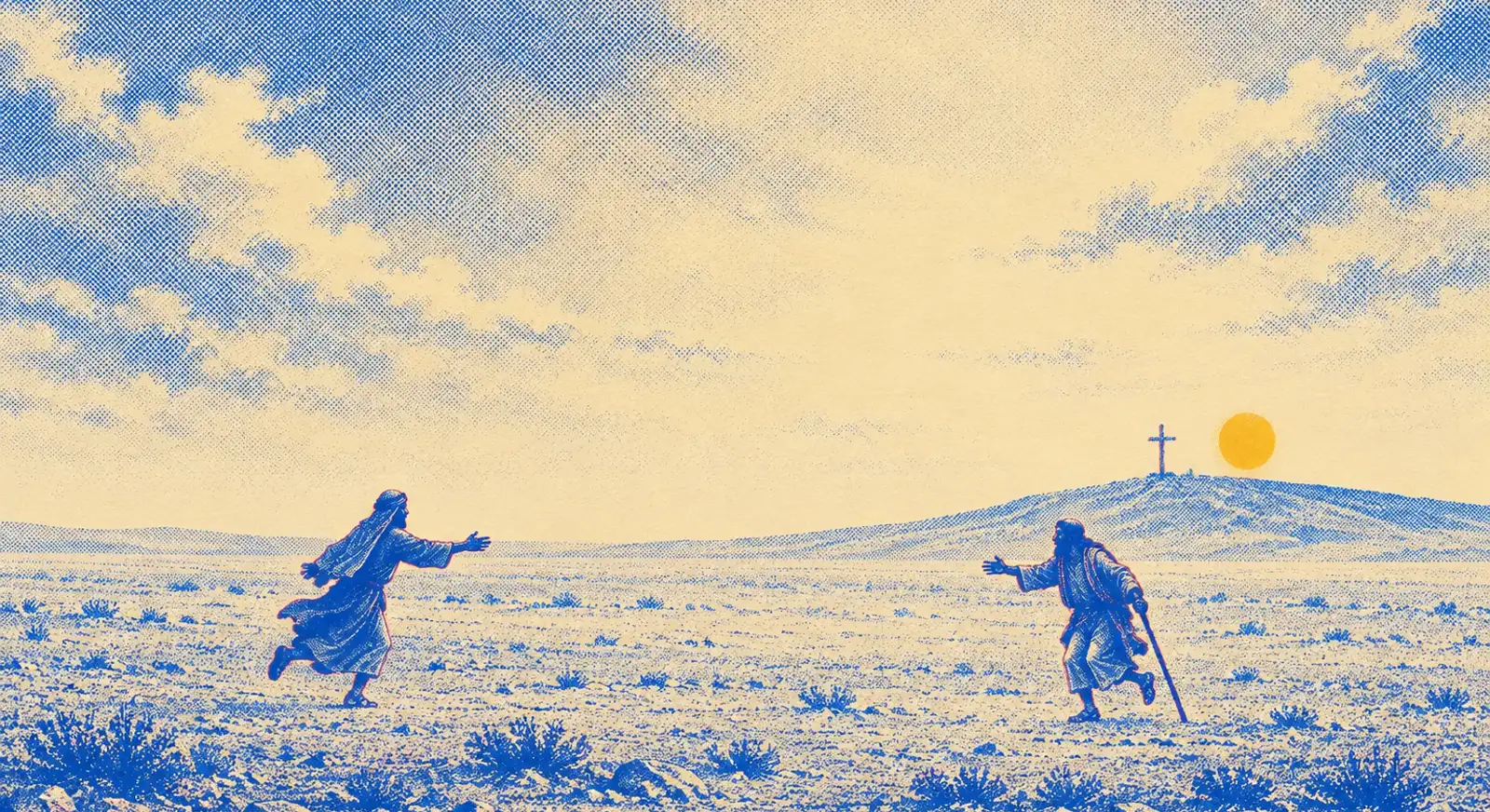
So a Christian comes to God like Jacob in one way. We come holding on to someone else's heel. We do not come to get ahead of him. We hold on because he was struck for us, and holding on to him is the only way in.
Prayer
Lord Jesus, you were struck so that the serpent would be crushed. Your body was given, and the curtain was torn from top to bottom. I have spent a lot of my life trying to get ahead of other people and trying to earn a place with God. Teach me to hold on to you instead. Let me come near with a clean conscience, and let me welcome the people you have made clean. Amen.
This week
I will draw near to God through Christ, and I will stop calling unclean the people God has welcomed.
Let God, out of His compassion, having no regard to the evil which is in me, and having regard to the good which is in you, grant us all grace that truth may not be overcome in my hands, and that falsehood ...
Blaise Pascal · Pensées
Method
By Heart, the Slow Way
You already know how to memorize; you have just been calling it listening to music.
Choose one short, whole thing: a psalm, the Beatitudes, a single paragraph.